Wednesday, December 10, 2014

==>Introduction!

Welcome to the (constantly) updated SuperCheats Unofficial Walkthrough and Guide for The Simpsons: Tapped Out.

Tapped Out is what is known in modern video game circles as a "freemium video game" and/or a "Freemium-Grinder" type game created for Android, iOS, and Kindle Fire, which is based upon the animated TV series The Simpsons.

Originally developed and published by EA Mobile Studios and launched in early 2012, Tapped Out joined The Sims: FreePlay as the two anchor games in the new mobile gaming initiative launched by EA in 2012 with the expectation that the pair would represent the foundation titles for EA's exploration of the emerging Mobile F2P genre.

The amazing bit is that the success of both titles caught EA completely by surprise -- that is to say that the pair of ostensibly free games ended up being far more successful and far more profitable than anyone had anticipated -- particularly EA!

In its 2013 Q2 financial report EA revealed that the two mobile titles -- Tapped Out and FreePlay -- generated more revenue via Apple's online store than was earned through all other retail outlets, including EA's own digital distribution store, Origin.

Welcome to The Simpsons: Tapped Out Unofficial SuperCheats Guide!
Tapped Out alone is reported to have generated over $50 million net revenue since the release, serving to suggest that mobile gaming has fully arrived as a significant segment of not just mobile gaming, but for the video games market as a whole. 

Those figures are not surprising considering the popularity of the game and its addictive and easy to play structure, though experts and games journos consider the unique revenue model that was used in the creation of both games to be a major contributor to the overall success of the games -- specifically the decision on the part of the development and planning team to create the games with the ability for players to play the game fully without actually needing to spend any real-world money. 


Pay for Play?

Despite the fact that the game was created so that it could be played without actually spending real-world money, it will not come as much of a surprise that its structure was built to encourage the players to pay for value-added (what the game calls "Premium") content, and it should be noted in passing that acquiring many of the Premium objects, structures, and characters really does enhance the player's ability to obtain both in-game money and to a lesser degree, the Donuts that represent the Premium currency. 

With all of that in mind it is therefore the focus of theSuperCheats Unofficial Guide for The Simpsons: Tapped Out to specifically focus upon playing the game WITHOUT spending any real-world money -- or ideally spending as little as possible.

Since the game includes a basic element or path that permits the player to obtain a trickle of Donuts without paying for them, adopting tactics and play styles that allow for advancement on game play alone, rather than spending money to advance your town or earn levels, is an obvious focus. Though it should be underscored that making the most effective use of the Donuts one does acquire as a natural consequence of game play is equally important.

Playing the game without spending money requires that gamers play strategically in what will very quickly become something of a trade-off, converting time for what money usually offers.

Adopting this tactic makes regular game play (and advancement) take much longer to acquire some elements for your town. The obvious pay-off to that is saving money, of course, but also in bragging rights and being able to create a town and progress through the missions and levels without paying to do so.

The guide is divided into logical sections, each covering different aspects of the game and game play, as well as information that will help you play the game with this approach.

To make accessing the information easier the structure of the guide is separated into multiple sections, and each section is initially organized with the various Missions and their Quests organized in a come-as-they-do fashion.

Once each Section of the Guide has been "completed" (that is to say that the guide moves on to the next Section) we may re-organize the Missions and Quests alphabetically in order to make locating and using that information quicker and easier.

The Walkthrough Section covers the actual mission and quest system, from level to level, with an eye towards helping you achieve the goals that are set out by the mission structure as quickly and efficiently as you can without having to spend money.

It also provides guidance that helps in navigating through the confusing parts -- of which there are many -- as well as pointing out build strategies that are more efficient and thus lead to quicker successes.

The Reference Section covers facts, lists, and data that is useful in both building a better understanding of the game and its contents, as well as for making strategic decisions that will directly impact your game play.

The Trivia Section covers information you may find amusing and entertaining, but is strictly an optional read - it is there for your enjoyment.

While the game is at this point (Winter 2013 / 2014) quite mature, even if you are starting out as a new player you will find that you can easily establish a great town and make constant progress with the assistance provided in this guide.

Knowledge is power, after all, and as one of the most effective secrets to success in playing Tapped Out is to avoid making mistakes that cost you time, making use of the information, tips, tactics, and strategies that are offered to you in this unofficial guide is a very good idea.

A bit of distraction sets the plot in motion in Tapped Out

What this Guide Is

The Simpsons: Tapped Out is what is defined as a "Freemium Grinder" -- which is a new and emerging class of free-to-play mobile platform game of the freemium variety, which means that it is free to play but slow (hence the grinder appellation) and while it is free there are decidedly not-so-free elements to it that firmly encourage the player to spend money. 

After all, the whole point behind the creation and publishing of such a game is to make money, and a publisher cannot accomplish that goal when they make things too easy on the player! 

In Tapped Out the gamer will find a game that has been very well and even fairly balanced, with the combination of free and paid content being carefully weighed and balanced so that neither is given too much emphasis, and the player therefore need not (and likely will not) feel any resentment one way or the other. 

This is an important consideration and it is equally important that we acknowledge that balance, because it is rare in the world of freemium gaming. In fact only a handful of publishers and game developers genuinely seek to strike such a balance -- EA being one. 

Finding that balance means offering gamers a mixture of challenges, and as is the case with all games of this type, once that reasonable balance has been found and there is a walkable path for free play, the studio need offer no excuses when it then steps in and creates different mechanisms to speed up game play, and allow for the players to obtain the special (premium) items that radically boost productivity and income as well as harvesting XP. 

It is fair to say that in many ways the strategies being applied have the player playing the game on an entirely different and uncommon level that is largely outside of the traditional game play system in that the new challenge is to find ways to beat the game maker, as well as the game itself. 

In the end the real trick in playing these games is decidedly to find ways to obtain almost all of the benefits available without actually spending real-world money. 

In other words your challenge is to find ways to play the game conveniently and pleasantly without spending your real-world money, and when you do that, you win. That is the specific function of this guide.

The Story -- An Overview

That venerable idiot Homer Simpson is ultimately at fault for a disaster that destroys the town of Springfield, Oregon and the surrounding retirement community of Springfield Falls, the survivalist village of Springfield Green, and an old logging town now converted into a theme park called Krustyland.

Employed as the Senior Safety Officer at Springfield's Nuke Plant, Simpson occupies one of the critical monitoring and safety stations commonly knows as a "Reactor Safety SCRAM Station."

The name of the safety station is actually an acronym that stands for Safety Control Rod Axe Man -- a job created by the U.S. Nuclear Regulatory Commission, and required by law for the safe operation of plants of the type found in Springfield.

Basically there are multiple SCRAM Stations at every plant, and each are fitted with exactly identical instruments and controls that permit their operators to monitor nearly every aspect of the plant and its reactors and cooling systems, including temperatures for all critical and backup systems throughout the cooling network.

When trouble is found -- but for that to happen it is necessary for layer upon layer of redundant safety inspectors and systems (some of which are actually automated) that exist between the SCRAM Station and the physical plant to somehow fail.

This is so unlikely as to border upon the impossible. So unlikely in fact that one of the premier experts on safety in the nuclear power industry was heard to comment that for the situation to get so bad that a SCRAM Safety Officer actually has to slam their palm down on the large red plunger that is, naturally enough, labeled "SCRAM" that plant would have to be under attack.

If that does not put the matter in perspective for you, perhaps this will: most dictionaries define the term “Scram” as “A rapid emergency shutdown of a nuclear reactor.”

That may seem like a reasonable definition but Ironically the Senior Safety Officers who are trusted to actually judge the circumstances that are required to initiate a SCRAM Shutdown have a very different definition for the term: they define it as meaning “to place the reactor in a safe condition.”

I don't know about you but I like the second definition better than the first. Just saying.

Anyway this is a video game not real life, and in this video game the threat that came to cause the plant to blow was not a terrorist attack, but rather a Freemium Grinder Video Game and a case in which the SCRAM Safety Officer (in this case Homer Simpson) grew so narrowly focused upon the game -- darn those bunny rabbits! -- that he was playing that he failed to heed both the audible and visual alarms that were ringing.

The result? Complete and total loss of the plant and its surrounding communities.


Burns Electric Company


The Springfield Nuke Plant is part of a larger company called Burns Electric -- and based upon information that was uncovered through a number of episodes and thanks to the activities of an Asian spy, was revealed to be a "Fissionator Slow-Fission Reactor" originally built in 1952.

That happens to be the type commonly referred to as a "breeder reactor" that has the dual function of creating power as well as weapons-grade plutonium, which makes up a significant portion of the large amount of waste that Mr. Burns regularly struggles to get rid of on an almost daily basis!

That aspect of the plant appeared in two of the episodes, most notably in the episode in which an Albanian Spy named Adil Hoxha -- who appeared to be a ten-year-old foreign exchange student -- infiltrated the plant as part of a tour group.

Thanks to an overly communicative Homer Simpson the spy was able to easily take all the pictures they wanted as well as obtain infrastructure and design information for the plant.

In most episodes Homer's job is shown to be that of "Safety Inspector" -- which is a white collar position usually staffed by an engineer who is part of the management team on the ToO -- Homer's workspace and workstation appear to be an overly-simplified interpretation of what would, in real life, be called a Safety Cut Off Station, or SCRAM Station.

Throughout the year special holiday-themed events will take place
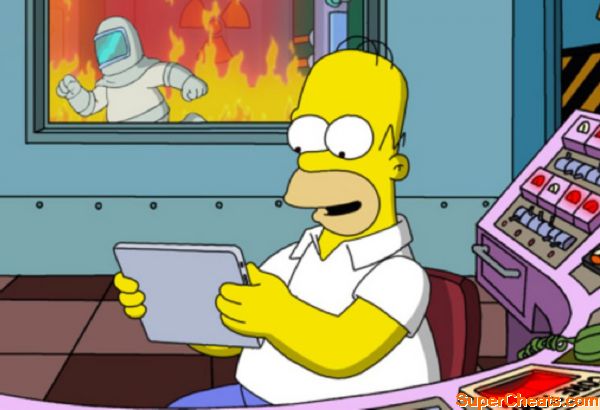
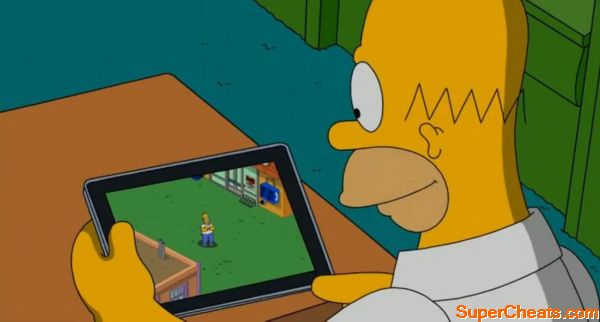
As the game begins Homer is seen holding his "myPad" (the Springfield version of an iPad) upon which he is playing a Mobile Gaming App called "The Happy Little Elves" (a parody of the animated cartoon series The Smurfs) -- with the intensity of the turn-and-time-based game causing him to be somewhat hyper-focused upon the game to the exclusion of all else. 

Appearing to be very frustrated by the game and its game play style -- which forces the player to wait after each action in the game before they can complete their next action -- basically they are talking about the same freemium system that the game uses -- Homer decides to skip some time. 

Tapping into the RMP (Real Money Purchase) system in the game, Homer chooses to buy a significant quantity of Happy Little Elf Berries (the in-game item that can be universally applied to the different game play elements in order to speed up the game and its turn system), only to discover that the purchase actually costs him $1000 in real money! 

The distraction of the game combined with his frustration and the realization that he has spent a large sum of money, we hear him declare that he would blame the purchase on one of his kids in order to obtain a refund, as if THAT would work LOL. 

With Homer's attention very effectively distracted, the alarms sounding and the catastrophe that is unfolding goes largely unnoticed by him until it is way too late. 

The plant has a core meltdown, which then contributes to the conditions that are necessary to foment a catastrophic explosion at the plant that literally destroys the entire city of Springfield -- setting the stage for the story in the game. 

If you are not a fan of the series it may help you to know that the Springfield Nuclear Power Plant, which is owned by the iconic series character Montgomery Burns, is notorious for being poorly maintained, poorly run and inadequately supervised. 

A level of haphazard maintenance of such that it, combined with the unwillingness of its owner to spend the money required to bring it up to code and make it safe, creates a long-running theme in the television show that is a mixture of an ironic juxtaposition and unlikely humor. 

To put that in perspective for you, in the animated series there are elements that represent the safety flaws that routinely appear in both the opening sequence and the background during each show because like the plant security they are for the most part a running joke. 

Examples include Homer accidentally taking fuel rods home with him in accidentally in his clothing, and when he discovers this that discovery triggers something of a running gag -- with different things happening to them as a result. 

Another running gag is the past effects of the disastrous waste disposal policies at the plant, which are illustrated by irradiated glow-in-the-dark rats, skeletal remains of employees previously sickened and deceased through exposure to the toxic and radioactive waste are often seen stored in the basement of the plant, and throughout a number of episodes glow-in-the-dark people, three-eyed fish, and giant spiders can be seen.
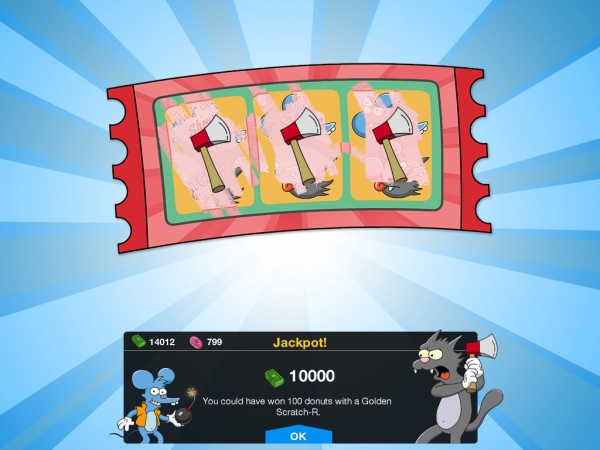
Playing the scratch ticket game at Kwik-E-Mart can pay-off big!
The odd leaking pipes in the bowels of the plant, improperly stored and leaking barrels of toxic and radioactive waste and a plethora of other serious safety violations contribute to an over-all highly negative impression of the plant that requires no verbal explaining or narration. 

That probably serves as sufficient background to fill you in on the nasty safety violations that have been caused by Montgomery Burns' unwillingness to properly fund the safety and waste disposal side of his business -- but as you play the game keep an eye out for the barrels of waste that appear in odd places both in the plant and its urban and suburban environs -- that too is something of a running gag. 

The presence of unusually high and very unsafe levels of radiation around the plant and its environs are witnessed in the form of very high readings on Geiger counters. 

That radiation is caused by the partial melt-downs that have taken place on numerous occasions that were prevented from transitioning into complete melt-downs by Homer's unusually effective dumb luck in dealing with these emergencies in a case-by-case fashion as part of the sub-plot for each of the episodes in which the events took place. 

As a side-note, the rather tongue-in-cheek rip on what has to number among the most popular mechanism used in freemium games today -- the time-delayed action system -- is just the sort of thing that the creators of The Simpsons are well-known for.
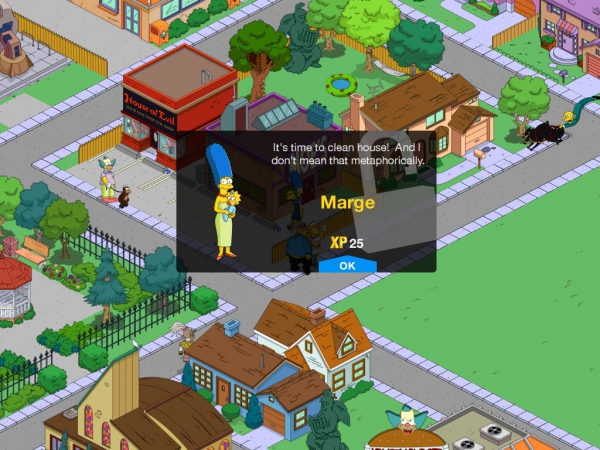
Each new character means more earning power and more tasks unlocked!

The Story Established

With the town now completely destroyed, the challenges and the basic theme has now been revealed to the player: 

Homer (with the help of his family and friends) must rebuild Springfield from the ground up, and the basic game play theme is now complete as this quest-based city-building game play adventure unfolds. 

In order to accomplish his goals of rebuilding Springfield the way that he (you, the player, actually) wants it to appear, it is necessary to complete a highly ordered and structured series of interlocking missions, quests, and their related tasks, as well as gap-quests that are used to stretch out game play in terms of time and effort, and to help the player to generate income in order to pay for the construction costs. 

This is primarily the set of activities that the player must embrace in order to obtain the money that is required to progress the reconstruction of the town, though they are not compelled to build it in any specific or set pattern beyond that dictated by Level restrictions. 

To make life more interesting and add to the challenge of building and maintaining your city the developer added a multi-player aspect to the game permitting players to visit with each other, not merely adding a social interaction subsystem to the game, but potentially offering gamers the chance to explore a narrowly defined sense of Schadenfreude by going after key and valuable elements in their friend's town --sadly that ability to steal items from your Neighbor's towns has since been removed from the game.The Sincerest Form of Flattery
Players who have created their own city, having progressed to a reasonable level of development, and who have attached their game save to their external gaming and/or social media accounts, now have the option to add the cities of up to 100 friends to their game.

This allows you to visit your mates -- and for your mates to visit you -- to assess how well the reconstruction is going and to see what unique designs and layouts you have devised.

This also permits you (and your mates) to pick up some extra XP and money along the way, as well as Donuts under specific circumstances!

Bear in mind that every player can add their friends via Facebook, Gmail, and their EA Origin Account, and leverage their device's contact list to create their own Simpsons social network.

After the player has added their friends, they can then visit each personal versions of Springfield to complete up to three unique tasks each day (included among which is the ability to vandalize their friends city) -- and when special events are active there may also be special activities or collections that players can complete while visiting their Neighbors!

The maximum number of friends that you can add in your Tapped Out game is 100, and once you begin adding them and start visiting them your mates and their worlds become part of your game in an existential manner, making them -- and you -- a part of your personal and ongoing story!

Showing Off?
The process of rebuilding your Springfield taps into a creative spirit for most gamers, and in no time you find yourself employing a wide variety of techniques in the design process. Perhaps you are recreating street layouts from your real-world town? Maybe you are building Springfield the way that you think it should have been built all along?

Either way you will quickly discover that you are not alone in that creativity and, as you visit more and more of your Neighbor Springfield you are sure to find approaches that you never thought of yourself -- but clearly your mates won't mind when you "borrow" their ideas, right? Right!

The creativity and art flow that comes from building and designing a city has really caught on with the community of gamers in Tapped Out -- in fact the art form is overflowing and honored! So honored in fact that the folks over at EA have even created a special section on the official chat boards where you can upload screen snaps of your town or what you consider to be its best features so that they can be judged by others!

Remember this is a game -- it is about having fun!

Basic Game Play

Before we discuss any other aspect of the game and basic game play there are several elements that have generated more messages -- and more frustration -- than any others and that have to do with how the game treats you and your identity, as well as how to access the various configuration options in the game.

While we cannot tell you how to gain full control over your game -- that does not appear to be possible when using the user game client -- we can tell you how to make sure that you have all your identity ducks in a row. Unfortunately that begins with dealing with some stuff that falls outside the realm of your myPad!

Tapped Out is a net-aware game and requires an active net connection to play

Your EA Origin Account

So, first thing you want to do is square away your account on EA's Origin Service. 

The reason that I mention to square it away is in 2012 there was an issue with security and EA basically reset a lot of accounts -- so you may need to go into the service and do the whole set new password thing before you can access it. 

If you are going to do that (you should anyway) you may as well make sure that the correct information is present on your account... 

If you are not aware of this, Origin is EA's combination online store, digital distribution service, and basic gamer identity system. In a nutshell it is how EA plans on organizing its games in the future and keep track of all of your DRM and licenses, as well as what you own and what you paid for (there is actually a serious distinction between the two mind you). 

Point your Web Browser at the URL "http://www.origin.com/" -- which will actually forward your connection to the server "http://store.origin.com/" so do not panic when it does that, it is working as intended. 

After that page fully loads, click on the link "LOGIN" located on the upper right corner of the browser, and then enter your email address and the password that you used for your Origin Account. 

If you do not have an Origin Account now is the time to create one, being sure to remember the email address that you use in creating it, and the password you chose. 

Note that in theory you can also log in with your Facebook credentials -- and you may have actually done so in the past -- but there is no substitute for setting up a proper Origin Account and you should do that now if you have not already done so. 

Now that you know you have the proper login credentials for your Origin Account, load Tapped Out on your device BUT be careful NOT to tap the main loading screen! On the bottom left corner is an Origin Symbol that constitutes a button -- tap THAT instead of anywhere else on the screen and you will open the Origin Log In Window instead of just loading the game. Now log in. 

The window that pops up has the options for Origin, Facebook, and Google, as well as the ability to use your Contacts on your device -- basically this is so you can invite and add people you know to your Friend List on the service. 

If you know for a fact that people you know have and play Tapped Out, those are the people you want to add for sure. After you have taken care of adding or inviting your friends, you will be asked to confirm that you want to connected your current game to your Origin Account and you are good to go!
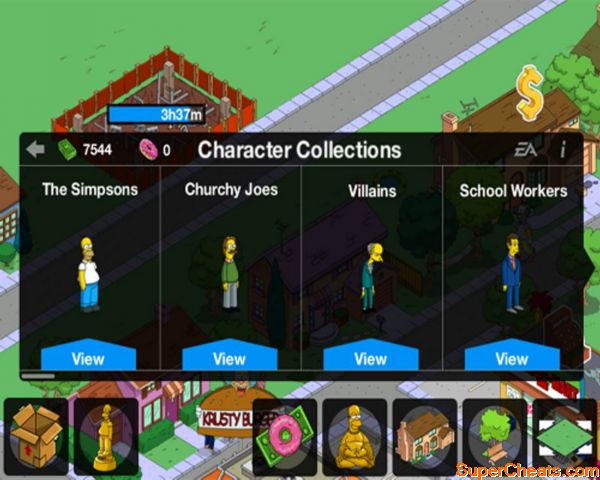
Completing any of the large number of character sets is a rewarding event

Back to the Basics

The Simpsons Tapped Out has as its primary focus the rebuilding of Springfield and the variety of buildings that you must buy with the virtual money you earn in the game or with the premium game currency (donuts) that you can buy with real-world money. 

In addition to buildings the player can also place landscape items like rivers, roads, pavement and decorations. 

As your town levels-up through completing quests, collecting from buildings, and helping out friends with their cities (you used to be able to steal items from their cities -- more on that elsewhere) the basic idea here is for you to move the story forward through completing quests and tasks, and for you to gain the levels that are necessary to obtain access to the higher level items, quests, and tasks. 

Much of that is accomplished through transactions, and these transactions make use of the two basic currency types in the game: dollars and donuts.Dollars are very easy to acquire in the game since most of the in-game economy and almost all of the actions you complete use them as payment.

Donuts, on the other hand, are not so easy to obtain, because while you will earn them in very small amounts as you level-up your character, they are used in the game as the choke-point and as its revenue stream, a common element in free-to-play mobile games these days.

In fact when the game first starts Homer takes a rip at that very process as part of the game play just before his distracted gaming results in the melt-down that destroys the town, which is the sort of humor you really have to expect from the wizards who created The Simpsons!

As Donuts are the defacto source of income for the game, a mechanism is in place to require them for pretty much every premium activity and action in the game -- that is not to say that you cannot play the game without spending real money on Donuts, because you can -- it will just play out a LOT slower if you do not.

Donuts are available from the in-game store for real-world money at a specific exchange rate (see the store section for details), an example of which is the box of 12 Donuts for £1.49 / $1.99 and the massive pile of 2400 Donuts at the other end of the spectrum, which will set you back £69.99 / $99.99.

Bearing in mind that having a pile of Donuts means you will be able to accomplish a lot of the actions in the game sooner than your mates who are Donuts poor, but again it is possible to play without buying them.

Where Dollars are spent on decorations and some buildings, Donuts are spent to speed-up construction delays, purchase premium buildings and items that usually have a special effect attached to them like increase the amount of Money and XP that you earn, basically desirable effects that will make you want to buy them.

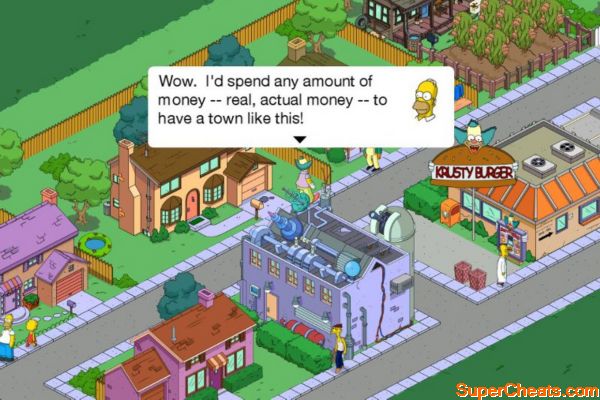
The level-motivated game play will quickly see you rebuilding your Springfield

XP Advances the Story

Almost every strategic action that you take in the game as you play pays in XP as well as Dollars (for income actions), and at least in XP (for improvement actions and quests). 

For example when you collect the revenue from your homes and businesses you will receive XP in addition to Dollars, and when you complete a task or quest you will also receive XP as a part of the reward. 

Placing some buildings pays off in XP alone, but harvesting the tax from the buildings pays in both. 

The scheme in Tapped Out is similar to that found in most games that use XP; it is required for the process of leveling-up, and that allows you to purchase additional items from the in-game store which are Level restricted. 


Conform-O-Meter

An extra twist has been put into the game in the form of the Conform-O-Meter, a meter that displays five stars and which reflects how well you are playing the characters in the manner that they would exhibit in the show basically. 

The meter ranks you by the number of stars you have earned -- from one to five -- and doing well grants permanent Money and XP bonuses. 

The process of increasing the rating -- adding stars -- means succeeding in boosting your ratings in consumerism, indolence, gluttony, obedience, righteousness, socialism, tree-hugging, and vanity -- basically a set of characteristics that appear to be at odds with each other, but then that sort of dichotomy is the foundation for much of the humor in the show! 

If that seems confusing well, no worries mates, the game was designed to help you figure all of that out in a very touchy-feely way: simply tap the star rating for the trait you want to learn about and the game will show you tips on how to improve that stat. 

For traits like tree-hugging, for example, you can boost them by planting more and more trees; for gluttony you can increase it by constructing more restaurants, and so on. Each has its own related item basically. 

The game is not really about the set of stats, rather they are a part of the big picture, and you will find it to be helpful advice to be reminded that concentrating on any one aspect of the game will, in the end, cost you a great deal of entertainment and amusement, and will likely cause you to miss many of the more subtle homage-based humorous elements. 

The game actually has a lot of that sort of thing, but treating it like a path towards winning (sorry Charley) is really not the way to go. 


Time Management

If you have not spent a lot of time playing this sort of game you may not be familiar with its basic mechanism, but if you have played titles like The Sims FreePlay in the past, you are very familiar with it. 

We are going to proceed here as if you are not, and outline the basic play strategies that you really need to employ to maximize your enjoyment and the benefit of your characters labor. 

To start with you should understand that there is not a lot of difference between the time you are actually logged into and playing the game, and when you are not. 

What we mean by that is even when you are not actively playing the game, the timer (clock) is still running, and things are happening, and the next time you log in to play you will find that jobs and tasks got done, and your characters may be idle and bored, waiting for the next thing to do. 

What you want to do is try to take advantage of that -- for example when you know you are not going to be playing the game for a number of hours, try to assign jobs or tasks to the characters that will take hours to complete -- that way when you log back into the game those jobs are done, your character spent less time idle, and it all translates into more money and XP for you! 

When you plan to play the game actively for a number of hours, assigning short tasks to your characters makes more sense as you will be there when they finish to assign them to another short task, and in the process you will build rewards faster that way. See what we mean about basic play strategy and time?
Be sure to tap Homer 10 times for free 10 Donuts and a free statue!

Conserving Resources

One thing you may not realize is that your efforts are a resource. 

The game was designed with the tutorial process built into the first few levels, and while you do not have to follow those suggested actions, it is really a good idea to do so AND to not stray too far on your own in adding custom buildings or other elements to the town. 

Really, the reason for this is simple: the basic tutorial is designed to provide your character with the basic set of resources that they need to succeed in playing this game, and if you focus upon just doing the jobs and placing the objects that the game asks you to do and place, what you end up with is a shortcut towards self-sufficiency, since the game has you add some buildings that actually serve as a source of money and resources. 

Once you reach the point where the game is no longer telling you what to do every other turn, that means you have exhausted the forced tutorial phase of the game, and that is fine, since that is when you pretty much can start making your own decisions on how to build the town. 

This has the added benefit of the game having helped you to create a basic infrastructure which will provide you with much of the income and capabilities you need to go further! 


Dollars to Donuts

One of the most important choices that you can make in the game is not to spend your Donuts on speeding up play. 

In fact you should be very reluctant to spend a Donuts on anything that does not pay a dividend -- basically if it is not an item that adds to your income, provides a special effect, or otherwise improves your strategic position, you should not be wasting Donuts on it! 

That is, of course, assuming that you do not plan to BUY Donuts using real world money. If you can afford to do that and you want to, then ignore this advice, spend your Donuts any way you like. 

If on the other hand you do not want to spend real-world money on them, then follow the above advice religiously! 

Before we end this basic play section, there are a few tips you may find very useful: 

(1) Purchasing the Springfield Sign will give you a 4.50% Money and XP Bonus every time one of your characters completes a job. You want to get this as soon as you can, but getting it as soon as you can will require you to spend real money, so you may be better off getting used to not having it. 

(2) Once you can do so, have Homer play with his myPad and, while he is playing with it, tap him ten times to complete a hidden Premium Action -- You will then be awarded 10 Donuts and a Jebediah Springfield Statue, which has the effect of maxing out your Vanity Rating, which is a good thing. 

(3) Try to make use of any special abilities that some buildings have -- use the farm to grow crops as much as you can. 

(4) While you always want to try to keep your characters (heh, I almost wrote Sims) working -- if they don't have a job, you will want to give them one -- you need to always remember that this game is built on the client-server model, which means it is actually EA's server that is dictating when you get assigned the special tasks and quests that advance the story and game progress. 

Because of that, you ALWAYS want to tap the button that takes you to the other Springfields and then after it loads, return to the game to force it to synchronize with the EA server BEFORE you assign lengthy tasks to any of the characters, because you will often find that when there is a forced task in the queue doing this will cause it to pop into your game. 

It really sucks to assign all your characters tasks and then get a forced task you can not activate because you assigned that character a task... 


That Should Do It

The information and tips in this section of the guide should be sufficient to allow you to hit the ground running and make easy progress in the game - assuming you remember them. But we are sure you will. 

Good luck, and remember, You are Having Fun.